


Killed for the Word, Forgotten in the Shadows: How a 19th-Century Painting Exposes Our Contemporaries
Blogs | 05 September, 2026 at 16:54 | 1,173 | Author: Olena Zelenina
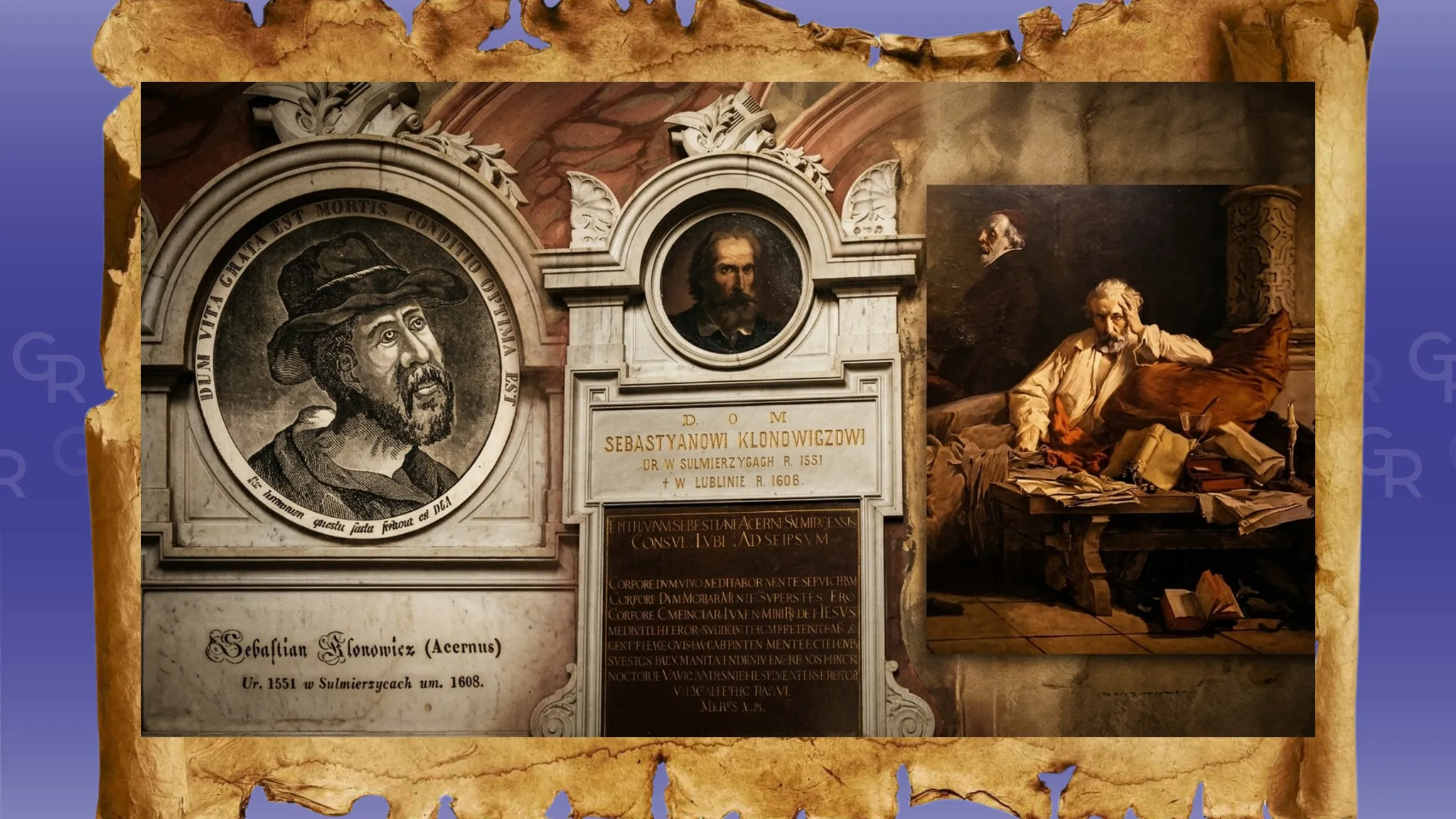
Collage by Olena Zelenina.
You know, there are canvases that act as a mirror through the centuries. You look at them and suddenly realize: the scenery, costumes, and technologies have changed, but human meanness, fanaticism, and conformism have remained exactly the same.
It is precisely this feeling that arises from Wilhelm Leopolski’s canvas "The Death of Acernus," created in 1867. My personal encounter with this painting took place in the halls of the National Museum in Wrocław — and it truly mesmerizes with its psychological tension and depth. By the way, regarding the artist's surname: "Leopolski" literally means "of Lviv" (from the Latin name of the city, Leopolis). A peculiar marker of belonging to the Lviv intellectual milieu, where bold humanistic reflections were born.
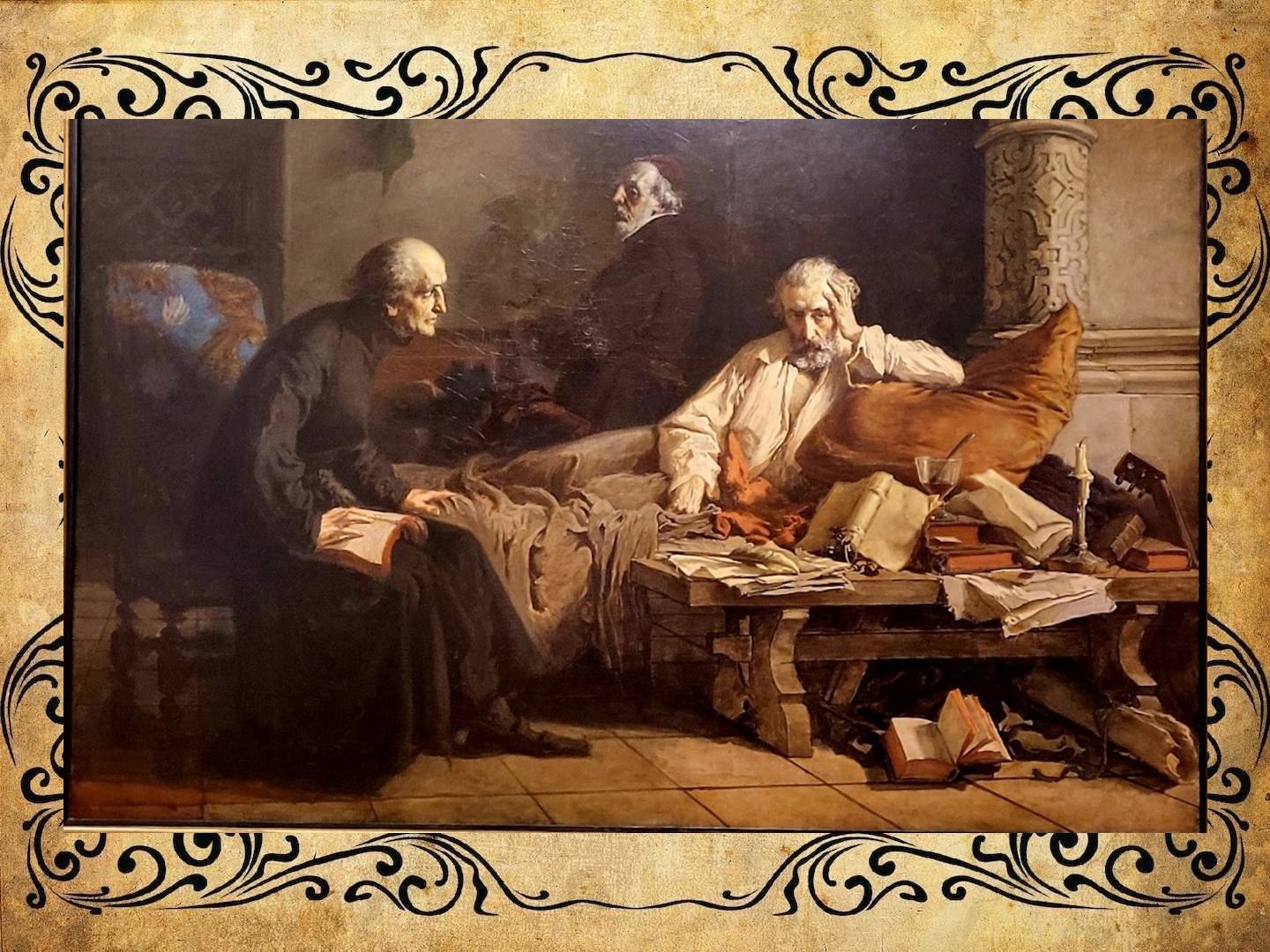
According to the plot of the painting, we are transported to August 1602. In the Lublin hospital of Saint Lazarus, Sebastian Fabian Klonowic is dying — a prominent poet, humanist, composer, and burgomaster of Lublin, who signed with the Latin pseudonym Acernus (from acer — maple). A man who advocated for religious tolerance, education, and the rights of townspeople made mortal enemies in the form of the Jesuit Order. His sharp satire "Judas of Roxolania" (Roxolania) triggered a devastating persecution campaign: the poet's books were publicly burned by an executioner in the city square, and Acernus himself was driven into poverty, illness, and solitude.
Leopolski depicts the final, almost detective-like in its tension, act of this tragedy.
A Battle on the Edge of the Abyss:
The Stubbornness of a Fading Genius Against the Vise of Dogmatism
On the right, upon the couch, is the exhausted, gravely ill Acernus. Around him lies intellectual chaos: scattered manuscripts, a desecrated book fallen under the table, a silent lute in the shadows, a burning-out candle, and an hourglass where the sand has practically run out. This is a classic still life in the vanitas style — symbols of a fading life and interrupted creativity. But pay attention to his posture: despite his physical frailty, a bitter, tragic stubbornness remains in his gaze. For him, to renounce his words is to kill his own mind.
On the left is a Jesuit monk. He presses the frail poet, holding an open church book, demanding a recantation of "heresy." This is the embodiment of a totalitarian ideology that seeks to subjugate not only the body, but also a person's very last breath.
The Shadow of Indifference:
Convenient Conformism That Kills No Worse Than Executioners
Yet the most powerful, masterfully hidden layer of the painting is the figure in the background. Standing in the shadow is Wojciech Oczko — a famous royal physician, scientist, and humanist. He sees the psychological torture, but demonstratively washes his hands of it.
Why? First, fear for his status and career at court. Openly standing up for the "cursed" author meant destroying his own well-being. Second, pragmatic self-justification: "as a doctor, I can no longer help with anything, and I shouldn't meddle in their religious dispute; it doesn't concern me." Oczko literally switches himself off from the event, turning into a silent bystander.
An Echo Through the Centuries:
The Wrocław Canvas and Painful Modern Analogies
When Leopolski painted this canvas in 1867, the Polish intelligentsia read it instantly. The January Uprising of 1863–1864 against the Russian Empire had just been brutally suppressed. Broken but unsubdued, Poland recognized itself in Acernus. Society was transitioning from Romanticism with its weapons to Positivism — the struggle to preserve culture, science, and intellect. Meanwhile, the figure of Dr. Oczko served as a painful reproach to that part of the elite that chose silent safety and conformism while the flower of the nation was being destroyed.
How does this resonate today?
The current worldview, unfortunately, lends these images a chilling relevance.
Censorship and Cancel Culture Through Repression
The burning of books and the hounding of Acernus by the Jesuits is a direct analogy to how modern totalitarian regimes (for example, the Russian aggressor) destroy Ukrainian literature, persecute cultural figures, and attempt to erase national identity. The weapon of culture and the written word remains the primary target for fanatics even now.
The "Indifferent Bystander" Phenomenon
The figure of Dr. Oczko is a mirror for a segment of modern global society or individual intellectuals who prefer to "stay out of politics." They see aggression and psychological or physical terror, yet hide in the cozy shadow of neutrality, reassuring themselves that "it's a complex issue" or "it doesn't concern us."
"The Death of Acernus" reminds us of a simple yet bitter truth: fanaticism destroys free thought, but this destruction is carried out precisely through the silent acquiescence of those who simply chose to stand in the shadows.
Acernus’s gaze, fixed upon his scattered manuscripts, is a simple and vivid reminder: freedom of thought and one’s own choice always come at a high price, but giving them up costs even more.

Comments
Some more relevant news for now